Certificates Attestation Services in Delhi: Secure and Hassle-Free Authentication Solutions
If you are searching for Certificates Attestation Services in Delhi, you are most likely preparing your documents for use outside India. This guide explains the full authentication process in simple terms.
Securing legitimate, legally recognized certificate attestation and Hague apostille authentication is the pivotal foundation for any individual planning an international move from India. Whether your upcoming overseas transition is driven by higher university education, corporate employment offers, expatriate work permits, commercial establishment, or family unification under dependent visas, sovereign authorities abroad demand certified proof of your papers. In this detailed guide on Certificates Attestation Services in Delhi: Secure and Hassle-Free Authentication Solutions, we unpack the administrative frameworks, ministerial departments, document prerequisites, and essential procedural steps to guarantee fast, compliant verification.
Why International Authentication is Mandatory
Every foreign sovereign government operates strict immigration control policies to guard against academic fraud, forged personal records, and unauthorized commercial operations. Foreign immigration officers and university admission committees cannot independently examine records issued by Indian universities, municipal corporations, or state departments. Legalization creates an unbroken, internationally accepted verification trail confirming that the seals, signatures, and issuing authorities on your certificates are fully verified by the Ministry of External Affairs (MEA), Government of India.
Without standardized authentication, your residency permit, employment visa, university registration, or business incorporation will be immediately halted. Depending on whether your destination nation is a signatory to the Hague Apostille Convention of 1961 (such as the USA, UK, Germany, Australia, France, or Italy) or a non-Hague nation (such as the UAE, Qatar, Kuwait, Saudi Arabia, or China), the authentication trajectory branches into either MEA Apostille or full Embassy Legalization.
Step-by-Step Document Authentication Workflow
The certification chain requires systematic progression through three to four designated tiers of municipal, state, and central government scrutiny:
Chronological Legalization Chain
Official procedure executed by accredited government authorities.
Notarization & Preliminary Scrutiny
The certificate undergoes initial scrutiny by an authorized Notary Public along with the applicant's valid passport. The Notary affixes the initial stamp, certifying the certificate's admissibility for state-level clearance.
State Level Authentication (HRD / Home / SDM)
Educational degrees must be certified by the State Higher Education Department (HRD) after university confirmation. Personal vital records (birth, marriage, death) are validated by the State Home Department or the Sub-Divisional Magistrate (SDM) in New Delhi.
Ministry of External Affairs (MEA) Government of India
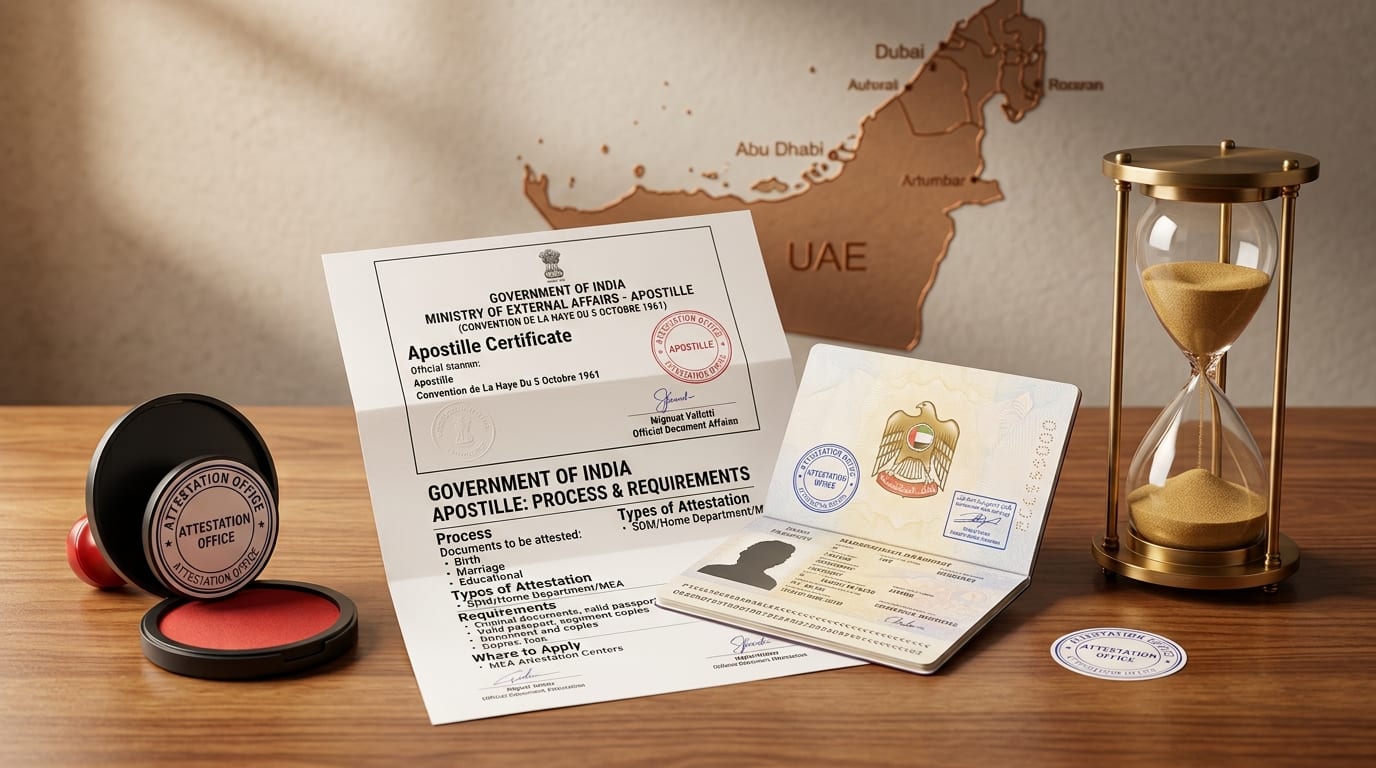
The MEA is the supreme central authority in India for foreign document validation. The MEA attaches either the official Hague Apostille sticker or central attestation stamp with an official QR code and federal serial number.
Consular Attestation & In-Country MOFA
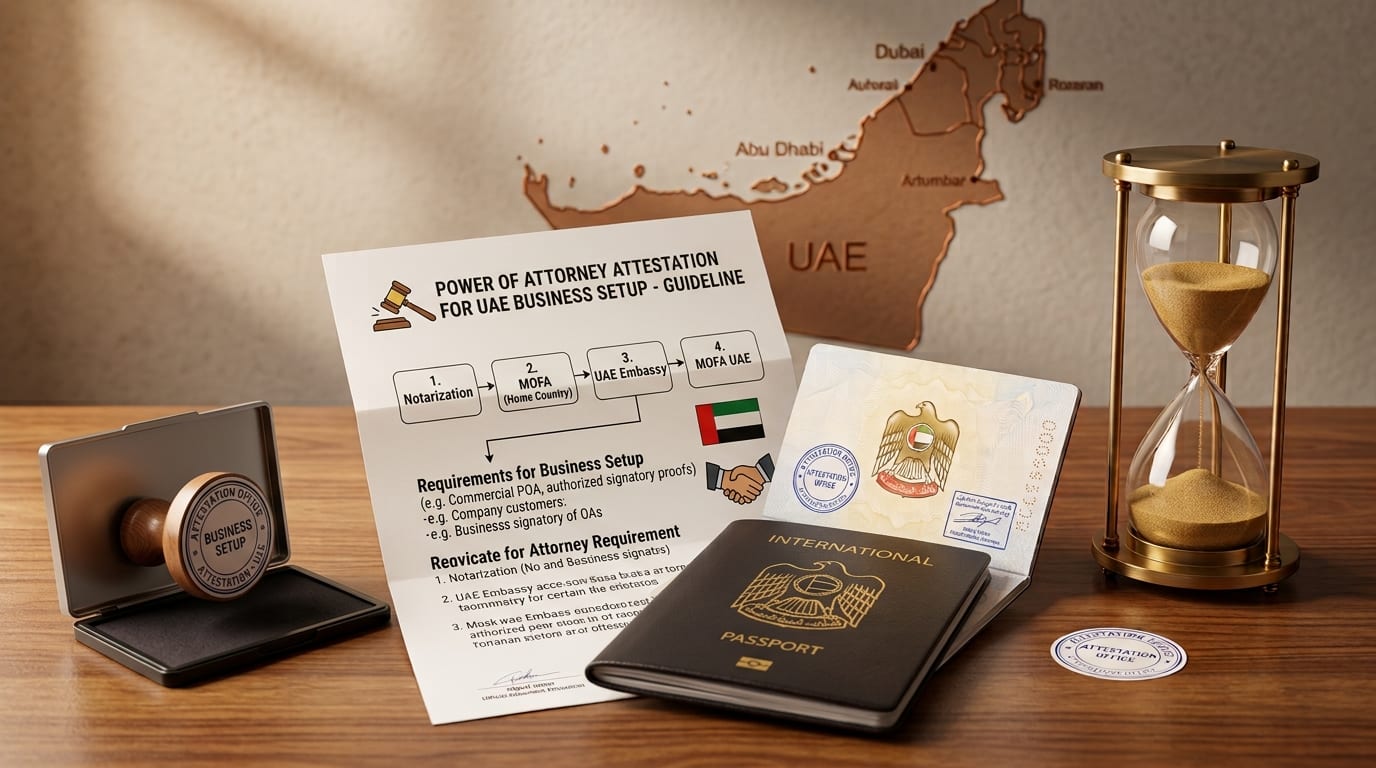
For non-Hague nations, documents proceed directly to the destination country's Embassy in New Delhi. Upon arrival abroad, the Ministry of Foreign Affairs (MOFA) in the destination nation applies the final validation stamp.
Required Documents Checklist
To guarantee swift, error-free submission without administrative rejection, applicants must assemble the following verified dossier:
- Original Certificates: Genuine, physical certificates free from lamination or physical damage.
- Passport Copies: High-resolution color copies of the applicant's first and address pages with minimum 6-month validity.
- Supporting Academic Transcripts: All individual semester mark sheets or consolidated grade transcripts for university verification.
- Affidavits & Translation: Sub-Divisional Magistrate name-change affidavits or sworn legal translations if original certificates contain vernacular languages.
Frequently Asked Questions
Q: What is the difference between MEA Apostille and Embassy Attestation?
Q: How much time does the full attestation process take?
Q: Can I track the progress of my documents during processing?
Get in touch with our certified legal attestation desk today for immediate document evaluation, free consultation, and prompt doorstep assistance across all major Indian cities.
Send Us an Inquiry
We guarantee zero third-party delays and instant verification help.